


Why a sensor drifts, and why it is dangerous
Sensors do not suddenly break. They slip. And a sensor that slips looks like a sensor that works.

Kim Djurhuus, founder
7 min read
The graph still looks fine
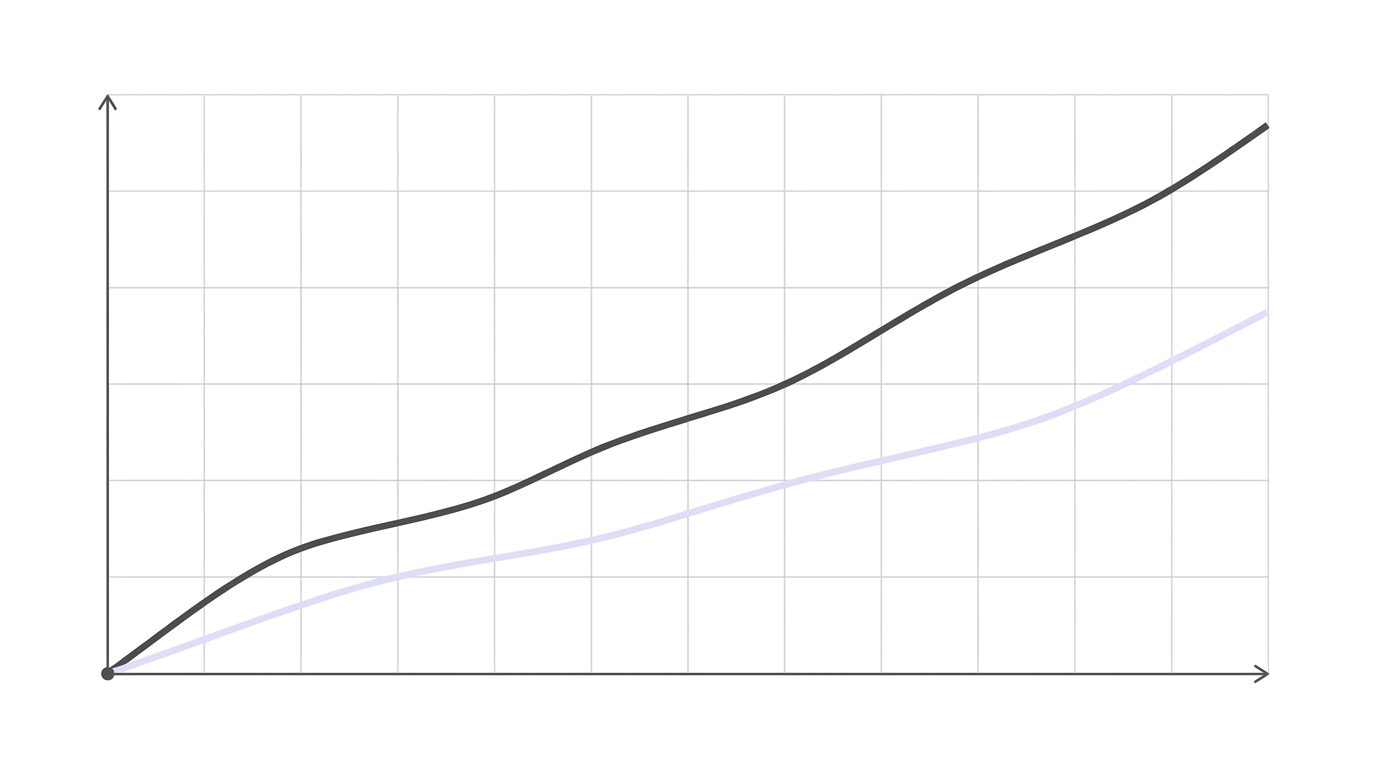
Drift is not noise and not dropouts. It is a slow, uniform shift of the entire measurement, which is why the graph looks exactly as tidy as before.
That is what makes drift more dangerous than an outright failure. A failure gets noticed. Drift does not.
What drift is
Drift means that the relationship between what the sensor measures and what is actually there changes over time. The sensor still shows a number, and the number looks reasonable, but it is offset.
A sensor that drifts half a degree a year will, after two years, be one and a half degrees out. The graph is just as smooth as on day one.
Why it happens
The measuring element ages. The materials change microscopically over time, with temperature changes and with humidity. That is physics, not a fault.
Extreme temperatures accelerate it. A sensor that lives at -80 or at +200 ages faster than one sitting in a refrigerator at +5.
Mechanical stress does too. A sensor that is pinched in a door every day, or a cable that gets bent, lasts less long.
Why it is dangerous
Because the alarm does not go off. The system compares the offset measurement with the limit, and as long as the offset measurement is within it, nothing happens.
In a ULT freezer this can mean the system reports -80 while it is really -72. The contents are damaged, and the graph still looks right.
And at an inspection the problem is twofold. The measurements are wrong, and there is no documentation of when it started.
That is why calibration intervals exist. Not for the sake of the paperwork, but because a measurement without a known uncertainty is not a measurement.
What calibration solves
Calibration compares the sensor with a traceable reference under controlled conditions and establishes how much it deviates at each measuring point, and with what uncertainty.
The certificate does not say the sensor is fine. It says how much it deviated. Assessing whether the deviation is acceptable for your application is up to you.
If the deviation is outside your acceptance criteria, the sensor is adjusted or replaced in your calibration rotation. If it is within them, it can continue, and you now know exactly how accurate it is.
How often
You define the interval yourselves based on your SOPs, typically every 12 months. Critical equipment and extreme temperatures may require more frequent calibration.
The most important thing is that the interval is kept without downtime. That is why we work with sensor exchange: we swap the sensors in your calibration rotation for freshly calibrated sensors, so the measurement never stops, and the calibration itself is done off-site by accredited partners.
What accelerates drift

Extreme cold
A sensor at -80 or -196 ages faster than one at +5.

Extreme heat
Ovens and autoclaves up to +200 put strain on the measuring element.

Mechanical wear
Pinched cables and daily door openings shorten the lifetime.
Frequently asked questions
Can you tell from the reading whether a sensor is drifting?
No. That is the whole problem. Drift looks like a normal measurement, and it is only detected by comparison with a reference.
How much does a typical sensor drift?
It depends on the type and environment. The expected drift after one year is one of the values stored in the Smart-Sensor's memory.
How do we avoid a gap in the graph during calibration?
With sensor exchange. We send a freshly calibrated sensor, you swap it, and the measurement continues.
Do we have to replace the sensor every time?
Not necessarily. Some can make do with a reference measurement. It depends on your SOPs and acceptance criteria.
Who keeps track of the intervals?
The system shows what is due for calibration, based on the intervals you have defined yourselves, and we coordinate the process.
Read on

Calibration
Accredited calibration via DFM and Dickson. We plan, exchange sensors and handle the certificates.
Read about calibration →Sensor exchange
Recalibration without downtime: a newly calibrated sensor in, the old one returned.
Read about sensor exchange →
How to read a mapping study
Heat maps, min and max, and what the figures mean for placement.
Read the article →Kom hurtigt i kontakt med den rette specialist.
Vi hjælper med alt fra nye monitoreringsløsninger til kalibrering, validering og teknisk support.
Generelle henvendelser

Nye projekter
IT & teknik
Administration
Besøg os
Måløv Byvej 229
2760 Måløv
Ring til os
+45 72 22 02 05
Man-fre, 08-16
Fortæl os, hvad du har brug for.
Vil du se, hvordan det ser ud hos jer?
Book en gennemgang. Vi kommer forbi, ser på udstyr og lokaler og rådgiver om, hvor følerne skal sidde. Derefter får du et skræddersyet forslag. Uden forpligtelser.
Book en gennemgang