


Monitoring of cold rooms and storage facilities
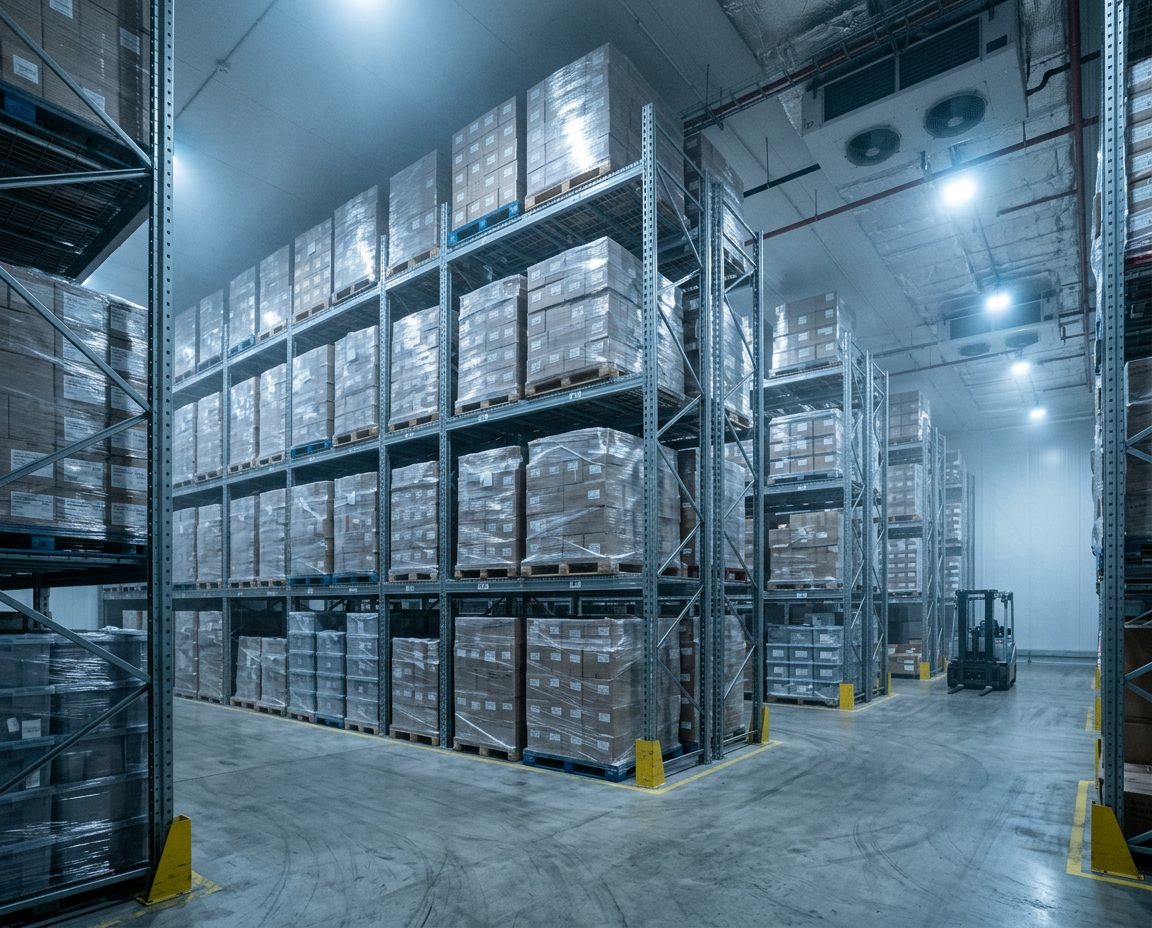
Large rooms do not have a single temperature. They have a distribution, and it changes with the season, with the load and with how often the loading door is open.
How many sensors does a cold room need?
It depends on the size of the room, the number of zones, air circulation and your own requirements. The number is determined from a mapping study that shows where the warmest and coldest points are. The fixed sensors are then placed exactly there, so they measure where the product is actually at risk.
A small cold room can often be covered with a few points. A large warehouse needs more, and often also measurements at both floor and ceiling height, because the difference there can be several degrees.
We advise on number and placement based on mapping data. The decision on scope rests with you, following your risk assessment.
The loading door is the biggest single factor
A cold room holds its temperature well as long as the door is closed. That is why most deviations in storage facilities are not caused by the cooling system, but by a delivery that took longer than planned.
Without a door alarm, this looks like an unexplained temperature rise in the middle of the day. With a door alarm, it looks like what it is: a loading door that stood open for forty minutes.
The difference matters, because one is a technical fault that must be fixed, and the other is a work routine that must be changed.

What we monitor in the room

Several measuring points per room
Placed according to mapping data, not where access is easiest. Often at both floor and ceiling height.

Loading doors and doors
Dry contact shows whether an open loading door is the cause of the deviation.

Temperature and humidity
Ambient storage without active cooling, where both outdoor temperature and humidity have an effect.

Cooling system and emergency power
Compressors and UPS via dry contact or 4-20 mA, so a technical fault is visible as the cause.

Mapping in summer and winter
The warmest point moves with the season, and that has to be documented.

Range in large rooms
One gateway typically covers the whole building. Metal racking and basements do, however, require an assessment on site.
OCEAView from DICKSON, set up and looked after by us
The hardware is DICKSON's. The software is DICKSON's. Everything between the equipment and your day-to-day work is ours. And once the system is in place, it is yours. You buy it, you own it, and no leasing agreement decides when you can switch, expand or stop. We take care of maintenance so it keeps running.
OCEAView
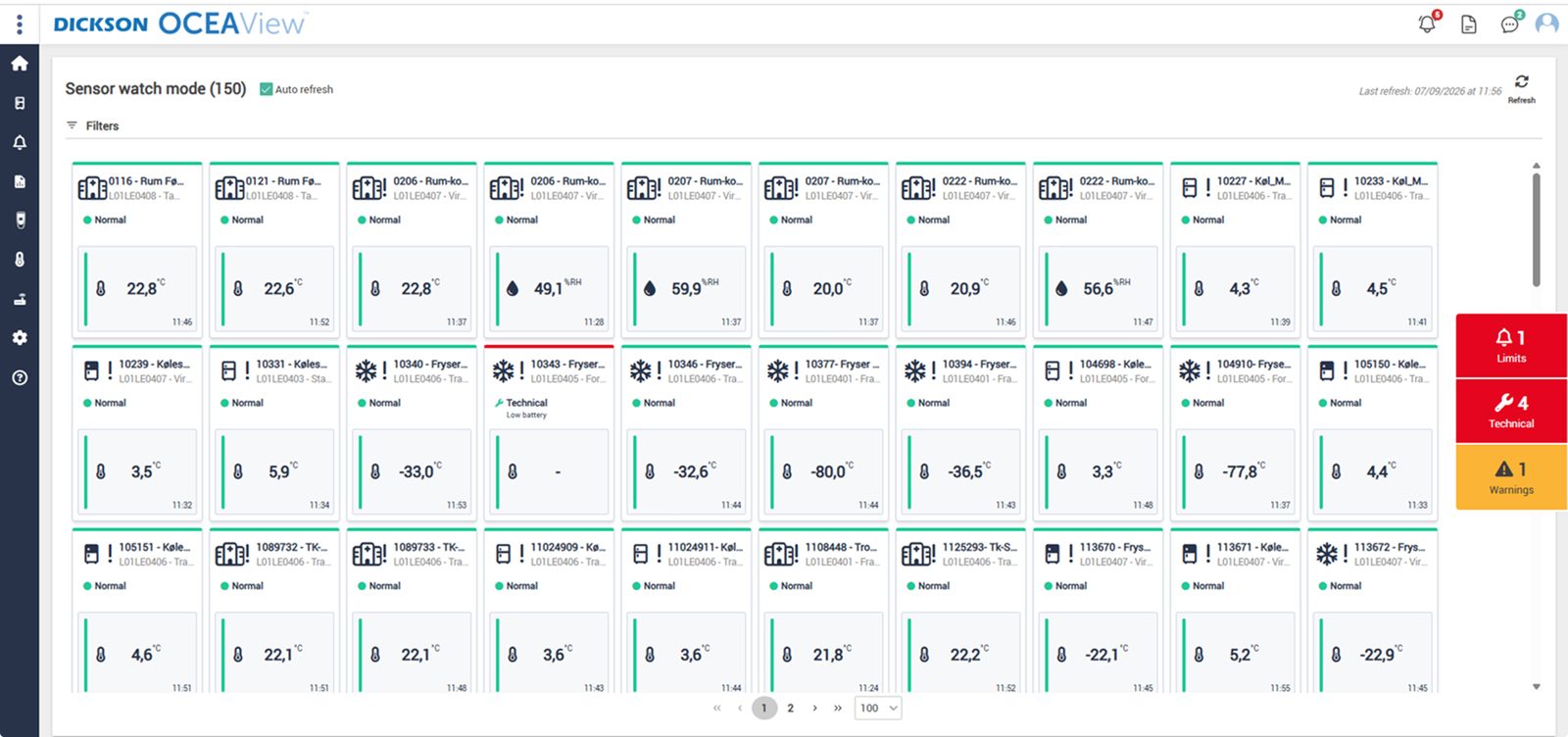
The whole setup on one screen. Watch mode gives a combined status overview of the equipment you have access to, with up to 100 units per page, and every graph can be zoomed down to the individual minute. Plan View also places the points on your own floor plan, so the person on call can see which room it concerns.

Audit trail that cannot be altered
Every measurement, alarm and acknowledgement with time stamp and user. That is what an auditor asks for.

Report in one click
Choose a period and pull the report as PDF or CSV. Ready before anyone asks.

Cloud or your own servers
On-premises runs at your site with LDAP, and you control updates yourself, so the qualification holds.
DICKSON
The manufacturer
Builds data loggers, sensors and OCEAView. French and American production, its own accredited calibration laboratories and CE, FCC and IC approved equipment.
Djurhuus IT
Distributor since 2018
We advise on placement, design the setup, install, set up alarms and on-call rotas, train your staff on the system and manage calibration afterwards.
You
Owner of the system
The system is yours. You set limits, response times and requirements according to your own SOPs. We supply the system and the documentation, handle the validation, on our own or in close collaboration with you, and maintain it afterwards.
Frequently asked questions
How many sensors do we need?
That is determined by the mapping study and by the size and zones of the room. We give a specific number once we have seen the room and know your requirements.
Do we need to do mapping first?
Yes, if you need to be able to document that the whole room stays within limits. Without the study, the placement of the fixed sensors is an estimate, and that is hard to defend to an auditor.
Do we need to map in both summer and winter?
If the room is affected by the outdoor temperature, yes. A study from January does not document July.
How do we avoid an alarm every time the loading door opens?
With a delay on each alarm limit, and with a dry contact cable on the loading door, so the cause is visible immediately.
Does the signal reach through a large warehouse with metal racking?
Usually yes, but metal and basements dampen the signal. We measure on site and position the gateway accordingly, or else we install an extra one.
Can we follow the goods out into transport?
Yes. An Emerald sensor in the shipment logs all the way and is read on receipt, so the whole chain is in the same system.
De bruger os allerede








Kom hurtigt i kontakt med den rette specialist.
Vi hjælper med alt fra nye monitoreringsløsninger til kalibrering, validering og teknisk support.
Generelle henvendelser

Nye projekter
IT & teknik
Administration
Besøg os
Måløv Byvej 229
2760 Måløv
Ring til os
+45 72 22 02 05
Man-fre, 08-16
Fortæl os, hvad du har brug for.
Vil du se, hvordan det ser ud hos jer?
Book en gennemgang. Vi kommer forbi, ser på udstyr og lokaler og rådgiver om, hvor følerne skal sidde. Derefter får du et skræddersyet forslag. Uden forpligtelser.
Book en gennemgang