


Monitoring of -80 freezers
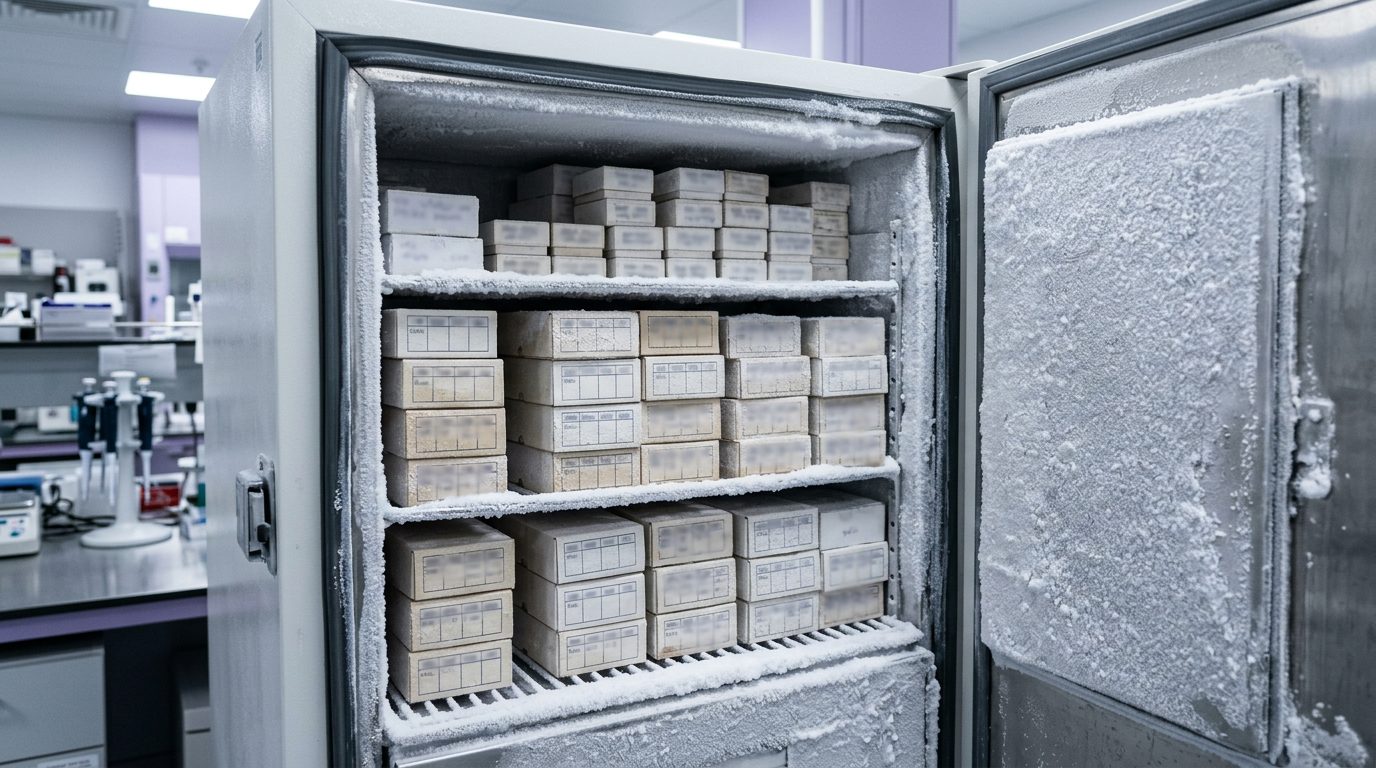
Ultra-low temperature freezers are used for what cannot be replaced. They warm up slowly, and that is exactly what makes them dangerous without monitoring.

How do you monitor a -80 freezer?
With a Pt100 sensor. Ordinary digital temperature sensors are typically specified down to around -40 degrees and drift below that, meaning they gradually read wrong without it showing in the number. Pt100 is a platinum sensor with a known and stable relationship between resistance and temperature all the way down to -200 degrees.
The sensor is placed inside the freezer and connected to a data logger outside. In addition to temperature, the door is typically also monitored via dry contact, along with the backup power, so the cause of a deviation can be seen straight away.
Limits and response times are set according to your own SOPs and to how quickly your freezers actually warm up during a power failure.
A -80 freezer fails slowly
A freezer rarely stops with a bang. The compressor deteriorates, the door gasket no longer seals tightly, or the condenser clogs with dust. The temperature rises a few degrees at a time.
This means the freezer can sit at -68 for several days without anyone noticing. The display still shows a minus figure, and everything looks normal. The damage to the contents happens in the meantime.
A monitoring system catches this kind of thing, because it sees the curve and not just the number, and because a warning limit can be set well before the actual alarm limit.
What we monitor on the freezer

The temperature in the chamber
Pt100 sensor placed according to a mapping study, not just in the middle of the top shelf.

The door
A dry contact cable shows whether an open door is the cause of the deviation.

Backup power and technical
UPS, compressor and the alarm output on the freezer itself via dry contact or 4-20 mA.

Escalation
A call to the person on call, then on to the next, until someone acknowledges. Not just an email.

Technical alarm
Notification of lost communication and sensor faults, so a silent sensor is not mistaken for a stable point.

Mapping of the chamber
A study of the distribution in the freezer, so the sensor sits where it is warmest.
OCEAView from DICKSON, set up and maintained by us
The hardware is DICKSON's. The software is DICKSON's. Everything between the equipment and your day-to-day work is ours. And once the system is in place, it is yours. You buy it, you own it, and no leasing agreement decides when you can switch, expand or stop. We take care of maintenance so it keeps running.
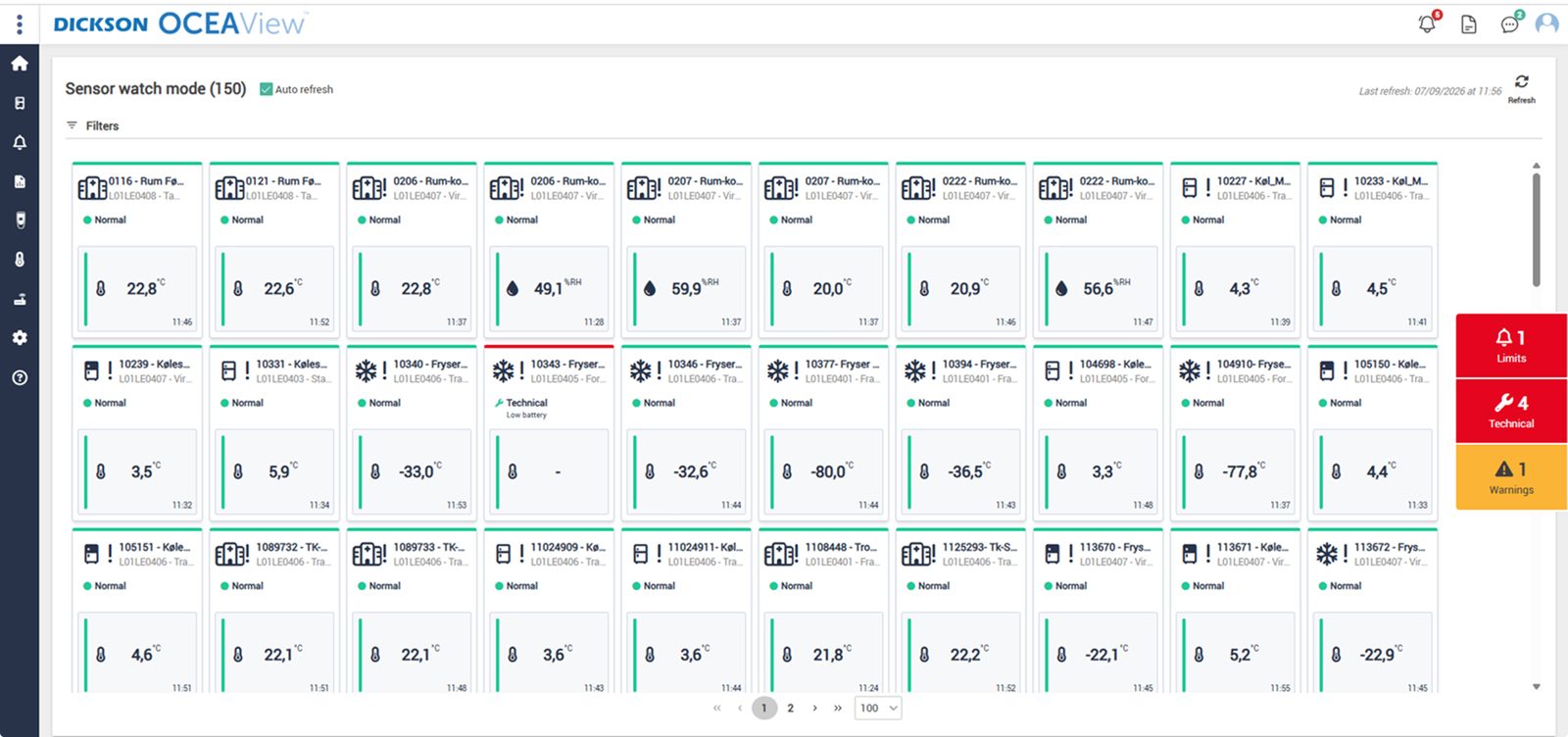
OCEAView
The whole setup on one screen. Watch mode gives a combined status overview of the equipment you have access to, with up to 100 units per page, and every graph can be zoomed down to the individual minute. Plan View also places the points on your own floor plan, so the person on call can see which room it concerns.

An audit trail that cannot be altered
Every reading, alarm and acknowledgement with timestamp and user. That is what an auditor asks for.

Report in one click
Choose a period and export the report as PDF or CSV. Ready before anyone asks.

Cloud or your own servers
On-premises runs at your site with LDAP, and you control updates yourselves, so the qualification holds.
DICKSON
The manufacturer
Builds data loggers, sensors and OCEAView. French and American production, its own accredited calibration laboratories and CE, FCC and IC approved equipment.
Djurhuus IT
Distributor since 2018
We advise on placement, design the setup, install, set up alarms and on-call rotas, train your staff on the system and manage calibration afterwards.
You
Owner of the system
The system is yours. You set the limits, response times and requirements according to your own SOPs. We supply the system and the documentation, handle the validation, on our own or in close cooperation with you, and maintain it afterwards.
Frequently asked questions
Why can we not use the freezer's own sensor?
The freezer's display shows what the unit itself measures, and this is rarely stored in a way you can document from. An independent sensor with traceable calibration is something different from the unit's own figure.
Where in the freezer should the sensor sit?
Where it is warmest, and that is best determined by a mapping study. The middle of the top shelf is a habit, not an argument.
How does the sensor get into the freezer?
Through the freezer's access port with a Pt100 sensor. We do not use flat cable through the door gasket on -80 freezers.
How quickly does a -80 freezer warm up during a power failure?
It depends on the model, how full it is and how often the door is opened. That is why delay and escalation are set up for your specific equipment, not by a rule of thumb.
Can we get a warning before the actual alarm?
Yes. You can set three levels up and three down, each with its own delay. A warning level catches the slow rise before it becomes critical.
Can we also monitor our liquid nitrogen tanks?
Yes. Pt100 rated to -200 degrees covers cryo storage, so tanks and freezers sit in the same dashboard.
De bruger os allerede








Kom hurtigt i kontakt med den rette specialist.
Vi hjælper med alt fra nye monitoreringsløsninger til kalibrering, validering og teknisk support.
Generelle henvendelser

Nye projekter
IT & teknik
Administration
Besøg os
Måløv Byvej 229
2760 Måløv
Ring til os
+45 72 22 02 05
Man-fre, 08-16
Fortæl os, hvad du har brug for.
Vil du se, hvordan det ser ud hos jer?
Book en gennemgang. Vi kommer forbi, ser på udstyr og lokaler og rådgiver om, hvor følerne skal sidde. Derefter får du et skræddersyet forslag. Uden forpligtelser.
Book en gennemgang